


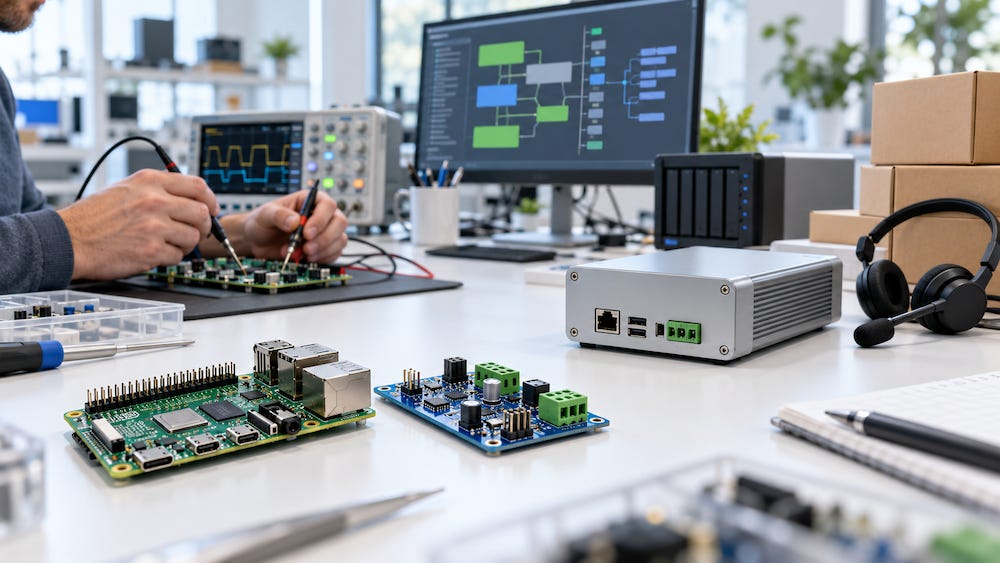
I regularly receive inquiries that begin with a question about one of our products and quickly develop into a description of a substantial business opportunity. The proposed market is large, the existing products are expensive, and inexpensive hardware apparently offers a way to compete at a much lower price.
Then comes the part where somebody needs to make it work.
Usually, that requires expertise the person making the proposal does not have. Sometimes there is no meaningful development budget. In other cases, financial resources may be available, but the technical work has not been sufficiently understood to estimate its cost. The opportunity is presented with considerable confidence; the development requirements remain much less specific.
A recent inquiry concerning marine electronics reminded me of a similar conversation several years ago about an Electronic Logging Device, or ELD. The markets were different, but the underlying argument was familiar: established products cost too much, the hardware could be purchased inexpensively, and a lower-priced alternative could capture a significant share of an attractive market.
It is a persuasive starting point. It is also an incomplete business case.
The Hardware Is Only the Beginning
The availability of inexpensive processors, interface boards, and communication modules has made sophisticated hardware accessible to small businesses and individual developers. That is a genuine advantage. Functions that once required substantial custom hardware development can often be demonstrated using readily available components.
But demonstrating a function is not the same as delivering a product.
The hardware still needs software that performs the required tasks reliably. It needs configuration, error handling, recovery procedures, testing, documentation, and a practical way to install updates. The finished system must also accommodate customers whose equipment and operating conditions differ from those used during development.
Lower hardware costs do not automatically reduce any of that work. A less expensive processor does not make a programming task take fewer hours.
One Product Can Require Several Development Efforts
The ELD proposal illustrates the issue. The envisioned product involved more than an onboard device. It also required a server-side system to receive, store, process, and present the information.
Those are distinct development responsibilities. The team working on the onboard equipment must address device operation, vehicle communication, data collection, and behavior when connections fail. The server-side team must address data handling, user access, application functions, and operation of the supporting service.
In a small organization, some people may contribute to both areas. Nevertheless, the work remains different and requires appropriate expertise. The two sides must also be integrated and tested together. Depending on the proposed product, mobile applications and other interfaces can add further development work.
Purchasing an inexpensive board does not provide those resources. Nor does a working prototype establish how much effort remains before the system can be sold and supported.
A Large Market Does Not Finance Development
Another recurring feature of these inquiries is the emphasis on potential sales. There may be hundreds of thousands of possible customers. Capturing even a small percentage would supposedly generate impressive revenue.
Perhaps it would. But a market estimate does not pay the people developing the product.
Engineering expenses begin before sales revenue arrives. Hardware must be purchased, software written, prototypes evaluated, and problems corrected. Applicable compliance requirements must be identified and addressed. Production, documentation, and customer support must be prepared.
Some expenses can be staged, and production can be organized in batches. Even so, somebody must provide the funding and accept the risk that sales will arrive later than expected—or fail to arrive at all.
A credible proposal needs to connect the market opportunity with a development budget, a realistic schedule, and a funded path to delivery. Without that connection, the revenue forecast is largely an expression of optimism.
Price Is Not the Same as Component Cost
It is easy to examine an established product, estimate the cost of its electronics, and conclude that the manufacturer is charging too much.
That comparison leaves out much of the business.
The selling price must recover development expenses and fund continuing software maintenance, technical support, warranty service, administration, and distribution. For a connected product, it may also need to support ongoing server infrastructure and operations. The company must then earn enough profit to remain viable and invest in the product’s future.
This does not mean every established product is reasonably priced or that a new competitor cannot improve the economics. It means a high selling price is not, by itself, evidence of greed. It may reflect the financial responsibility of maintaining a product and supporting the customers who depend on it.
A competitor promising the same functionality at a substantially lower price needs to explain which costs it can reduce and how. Pointing to cheaper hardware is rarely a sufficient answer.
Expertise Is Part of the Investment
For me, these inquiries also raise a practical question: who is expected to supply the missing technical knowledge?
An initial product question can gradually become a discussion of system architecture, development strategy, component selection, and project feasibility. Those subjects require professional judgment built through years of experience. They have value, even when the conversation takes place before a formal project exists.
I understand why an entrepreneur wants to explore an idea before committing money. But uncertainty about a business opportunity does not make the expert’s contribution cost-free. If technical guidance is necessary to establish whether the venture is viable, that guidance belongs in the project budget.
Inexpensive hardware can provide an excellent foundation for a new product. Turning it into a successful business requires funded development, capable people, realistic expectations, and a price that supports the responsibilities being accepted. Until those elements are accounted for, the inexpensive board is simply the least expensive part of the proposal.