


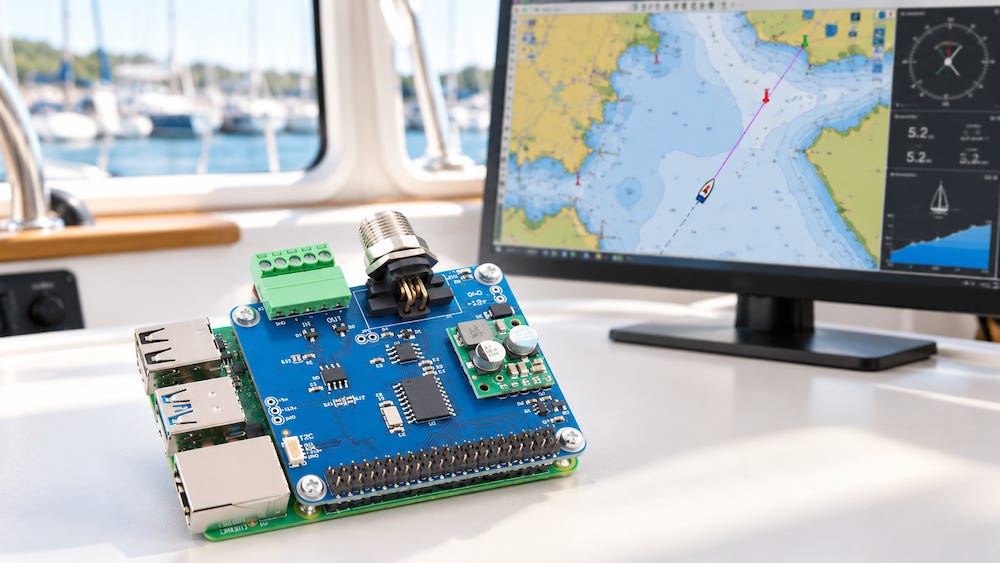
Recently, I received a somewhat vague inquiry concerning Raspberry Pi-based marine electronics and our PiCAN-M interface board. No specific project was proposed, but the wording of the message suggested an interest in exploring a commercial opportunity. The accompanying YouTube video presented an inexpensive Raspberry Pi system as an alternative to costly marine electronics.
It was not the first time the idea had crossed my desk. At Copperhill Technologies, we had already considered offering a computer system with NMEA 2000 and NMEA 0183 connectivity. With the PiCAN-M board in our product line, it was a natural possibility to explore. We ultimately decided not to pursue it.
That decision was not a rejection of the technology. A Raspberry Pi running software such as OpenPlotter and Signal K can be a useful platform for collecting, displaying, and recording marine instrument data. It also provides opportunities for experimentation and specialized applications. For a technically inclined boat owner, putting such a system together can be an interesting and worthwhile project.
Selling it as a finished product is a different undertaking.
The video’s headline centers on a $209 computer. That is an attractive number, particularly when placed beside an invoice for several thousand dollars of commercial marine equipment. But buying two circuit boards does not give you a complete, installed, supported marine computer. Someone still has to provide the power supply, storage, cooling, cables, and mounting hardware. Someone has to assemble the system, install and configure the software, test it, and explain how to use it.
If the owner does that work, the investment is partly money but mostly personal time. If a business does it, that time becomes a cost that must be recovered through the selling price.
There is also the matter of what happens after the package arrives. Copperhill Technologies is a small business, and we would not have technicians traveling around the country to install computers aboard customers’ boats. Installation would fall to the owner or a local installer. Questions about power connections, network wiring, missing instrument readings, and software settings would nevertheless find their way back to us. Supplying the computer would only be the beginning of that responsibility.
I receive proposals from time to time that start with inexpensive hardware and end with predictions of substantial sales. I understand the appeal. There is a large market for marine electronics, and the prospect of giving boat owners a more affordable, flexible way to use their instrument data deserves consideration. But the size of the broader market does not tell me how many customers would buy a particular product, what they would pay, or how much support they would need.
As a business owner, those are the questions I have to answer. Copperhill Technologies serves several technical markets beyond marine electronics, and every new product competes for the same limited development time and support resources. A promising concept needs to become a sustainable product before it becomes a business opportunity.
Nevertheless, the inquiry did inspire me to revisit the subject. In the following sections, I will examine the video’s argument and then work through the costs of supplying the proposed system as a commercial product. The Raspberry Pi approach has real merits. Understanding them requires a more complete comparison than the price of the boards.
What the Video Gets Right—and What It Leaves Out
First, I appreciate that the video mentions Copperhill Technologies several times, identifying us as the manufacturer of the PiCAN-M board. It is welcome exposure for our business and the products we offer. However, that recognition does not prevent me from taking a critical look at the video’s technical claims and economic assumptions.
The video builds its argument around the consolidation of the marine electronics industry. It describes how familiar brands, including Raymarine, Simrad, B&G, Lowrance, and Navionics, became part of larger corporate portfolios. It then connects those acquisitions with equipment prices, chart subscriptions, and the difficulty of moving away from an established manufacturer’s ecosystem.
Its intended message is clear: boat owners have more alternatives than the major manufacturers would like them to believe.
To support that message, the video introduces a Raspberry Pi computer with a PiCAN-M interface board, running OpenPlotter, Signal K, and OpenCPN. This combination can connect to existing marine instruments, make supported data available to other applications, and provide chart viewing and navigation functions. Instrument readings can also be displayed on a cell phone connected to the boat’s local Wi-Fi network.

There is a useful idea here. Boat owners can gain more control over how they display, record, and process their instrument data. Open-source software also gives developers opportunities to create functions beyond those supplied by an equipment manufacturer. Those are legitimate advantages, and they deserve an informed discussion.
Unfortunately, the video wraps that discussion in a much broader claim about corporate ownership, excessive margins, and an inexpensive route to independence. Its financial figures and technical descriptions create an impression of thorough research, but several of the conclusions go beyond what the information actually establishes.
AI Production Does Not Replace Technical Understanding
YouTube identifies the video as containing altered or AI-generated sound or visuals. That disclosure alone does not establish how the script was researched or written. However, the presentation illustrates a familiar weakness of AI-generated material: assembling plausible facts into a confident narrative without adequately examining the connections between them.
The visual presentation raises further concerns. Several computer screens and product images do not accurately represent the equipment or software being discussed. These appear to be AI-generated illustrations, although their origin cannot be established from appearance alone. In a technical presentation, such images can mislead viewers about what the proposed system actually looks like and how it operates. They reinforce the impression that the finished video was not adequately reviewed by someone familiar with the technology.
A list of references does not resolve that problem. A source may support an acquisition price, a product specification, or a revenue figure without supporting the conclusion drawn from it. Several important claims in the video are insufficiently substantiated, particularly where it moves from those individual facts to assumptions about technical equivalence, customer dependence, and business economics.
For example, the video repeatedly points to the substantial revenues of major marine electronics manufacturers. Those figures demonstrate the size of the businesses being discussed. They do not establish the potential sales volume for a Raspberry Pi-based marine computer. Revenue from a broad portfolio of chartplotters, radar, sonar, instruments, and other products cannot simply be treated as an available market for a small open-source data hub.
There may be a worthwhile market for such a product. The video does not establish its size.
The Technical Comparison Is Incomplete
The most obvious problem is the comparison between the proposed $209 computer and the expensive collection of equipment presented at the beginning.
A Raspberry Pi and PiCAN-M board do not replace every function represented by that invoice. They do not become a radar system merely because they can display instrument data. They do not include a marine display, and they still depend on sensors and other equipment to produce the information they process.
To its credit, the video acknowledges some of these limitations. It recommends retaining a commercial chartplotter at the helm and keeping the Raspberry Pi system in a protected location. That is an important qualification, but it also weakens the dramatic price comparison. If the owner retains the primary navigation equipment, the Pi is an additional system whose value must be assessed against the additional functions it provides.
The power arrangement also receives too little attention. The video presents the PiCAN-M’s onboard supply as a straightforward way to power both boards from the NMEA 2000 backbone. A Pi 5 installation requires a more careful assessment of the supply capacity, peripheral load, wiring, and available network power. For the commercial configuration considered here, I would use an independent power supply rather than assume that an existing instrument network can reliably carry the additional load.
Likewise, installing Signal K does not guarantee that every connected device and every proprietary function will become available. The required messages must be supported, connections must be configured, and the results must be checked. Displaying an existing reading through an available dashboard is one task. Developing a new application or supporting an unusual device is another.
The flexibility is real. So is the work required to use it.
The Economic Comparison Leaves Out the Work
The video’s central price covers two major components. It leaves out much of what turns those components into a usable product.
Storage, power conversion, cooling, an enclosure, cables, protection, and mounting provisions all cost money. Assembly, software configuration, and testing require time. A system installed aboard a boat must then be checked against that boat’s particular equipment and network.
A technically capable owner may perform those tasks personally. That can make the project economical, especially if the owner enjoys the work. But unpaid personal effort cannot be carried into a commercial cost calculation as though it does not exist.
A supplier must also prepare installation instructions, connection diagrams, troubleshooting guidance, and recovery procedures. After the sale, someone must answer questions when the phone cannot connect, an expected engine reading is missing, or the computer restarts intermittently. The cause may be the supplied product, the boat’s wiring, another instrument, or a configuration setting. Determining which one is responsible is itself technical work.
The video also uses gross margin as evidence of how much money manufacturers retain from their products. Gross margin is not net profit. The remaining revenue must fund engineering, software maintenance, support, administration, and other operating expenses. Its example of money spent at a dealer also overlooks the distinction between the dealer’s retail revenue and the manufacturer’s revenue.
None of this means that commercial marine equipment is always reasonably priced. It means that the video has not made a complete economic comparison.
My objection is therefore not to the Raspberry Pi approach. It is to the suggestion that inexpensive components demonstrate an inexpensive finished solution—or an obvious opportunity for a supplier to make money. Establishing either claim requires accounting for the work between purchasing the boards and delivering a system that a customer can install, operate, and obtain support for.
From a DIY Project to a Commercial Product
A Raspberry Pi-based marine computer is an attractive proposition in terms of both price and functionality. Combined with a PiCAN-M board and suitable open-source software, it provides a flexible platform for displaying instrument data, recording information, and running navigation applications. For a boat owner who is willing and technically capable of assembling, configuring, and installing the system, it is an entirely valid choice.
The economics change when a business offers that same system as a finished product. The customer is then paying for more than the components. They are buying an assembled, configured, and tested computer, together with documentation, technical assistance, and the expectation that somebody will take responsibility when it does not work as expected.
For our estimate, the hardware would include the Raspberry Pi 5, PiCAN-M board, PiCAN-M enclosure, microSD card, independent power supply, cooling, and the necessary connections. However, that does not include the larger expenses associated with supplying and supporting the finished system.
Those expenses include:
Assembly, software installation, configuration, and testing.
Online documentation, installation instructions, and troubleshooting guidance.
Technical support before, during, and after installation.
Customer service, order processing, and payment fees.
Packaging, shipping materials, and outbound shipping.
Applicable import duties, customs charges, and tariffs.
Warranty service, returns, and replacement units.
Ongoing software maintenance and compatibility testing.
Some of these costs occur with every unit. Others must be spread across an uncertain number of sales. Documentation, for example, requires substantial effort before the first shipment and continued attention as software and supported hardware change. Technical support is even harder to predict: one customer may need little assistance, while another may require hours of troubleshooting.
Taking these responsibilities into account, our preliminary estimate is a selling price of roughly $1,100 to $1,250 per unit. This is a planning estimate rather than a quotation, but it reflects the difference between purchasing inexpensive components and operating a business that supplies a supported product. The margin must cover the expenses beyond assembly and leave enough profit to make the undertaking worthwhile.
Even at that price, the system would still require installation aboard the boat. We would not have personnel traveling around the country to perform that work. The customer would have to install it personally or hire a local technician, adding either their own time or another invoice to the total investment.
Installation would also generate support requests. A missing instrument reading might result from software settings, unsupported messages, wiring, or another device on the network. From the customer’s perspective, however, the new computer is not doing what they expected. Helping establish the cause becomes part of the supplier’s workload, even when the supplied hardware is functioning correctly.
At this point, the comparison with professional marine equipment becomes much closer than the video’s $209 figure suggests. The Raspberry Pi system may still offer valuable flexibility, particularly for specialized applications, but its commercial appeal must stand on those capabilities and the complete delivered price.
That is why I distinguish between recommending the technology and deciding to manufacture a finished system around it. A capable owner can build something useful and economical by contributing their own time and knowledge. A supplier must charge for that work and accept continuing responsibility for the product.
Final Thoughts
I receive similar inquiries regularly, often accompanied by predictions of substantial future business. This particular inquiry prompted me to revisit an idea we had already considered: offering a Raspberry Pi-based marine computer as a finished commercial product. The technology remains attractive. The business case requires considerably more than inexpensive hardware and an encouraging estimate of market size.
For illustration, suppose there were 100,000 potential installations and we could convert 1% into sales. Those are hypothetical assumptions, not a market forecast. At approximately $1,200 per unit, the resulting 1,000 orders would generate $1.2 million in revenue. That sounds promising, but it says little about the investment required or the profit remaining. Our estimated selling price allows for the costs of supplying and supporting each unit; it does not establish the upfront funding needed to purchase inventory, develop documentation, and arrange sufficient personnel and production capacity. Manufacturing in batches would reduce the initial commitment, but somebody would still have to finance those batches.
The sales timeline matters just as much. Selling 1,000 units in one year creates a very different business from selling them over five years, while support and operating expenses continue throughout. Before committing, I would need credible evidence of demand at the actual selling price, a realistic sales schedule, and a return that justifies the money and time invested. A Raspberry Pi marine computer can be an excellent project for a capable boat owner. Turning it into a supported commercial product is a separate undertaking—and the inexpensive boards do not make that undertaking inexpensive.