


This article is part of CAN Bus Embedded Development, my growing online book about practical CAN Bus hardware, software, and embedded system development.
View the complete Table of Contents →
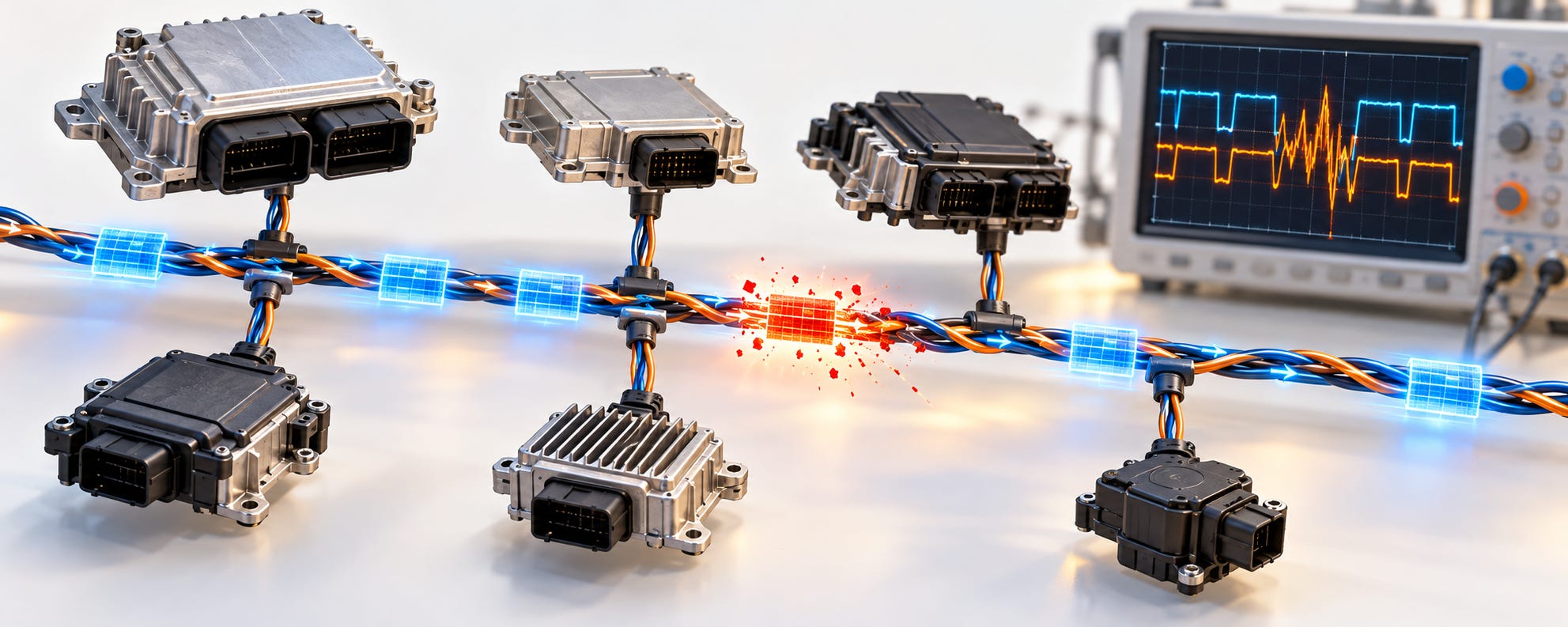
This post was inspired by a customer inquiry about simulating CAN Bus faults and capturing them with an oscilloscope. The customer wanted to create a collection of reference waveforms for troubleshooting networks in the field.
I was familiar with CAN Bus error detection, but deliberately simulating physical faults was not a topic I knew well enough to offer a detailed answer. The question made me curious, so I started researching the available methods and equipment.
As I discovered, some faults can be introduced with a relatively simple test setup, while others require specialized hardware. In this post, I will explain why error simulation can be useful and explore some of the ways to put a CAN network to the test.
For a market survey, see my post CAN Bus Error Injection: Available Hardware and Software.
Understanding CAN Bus Error Simulation
A CAN Bus network is designed to detect communication errors and recover from many of them automatically. But how can you be sure that your application responds correctly when something goes wrong?
One way is to deliberately introduce faults into a controlled test network and observe the results. CAN Bus error simulation helps developers, technicians, and engineers understand what failures look like, how CAN controllers respond, and whether an application can recover when normal communication returns.
Error simulation can range from a simple wiring change to sophisticated equipment that disturbs individual bits in a CAN message. The right approach depends on the fault you want to reproduce and what you want to learn from it.
Who Benefits from CAN Bus Error Simulation?
CAN Bus error simulation is useful both for evaluating an entire network and for developing an individual node. From a network perspective, it can reveal how wiring faults, incorrect termination, electrical interference, or a faulty transceiver affect communication. For a node under development, the focus is on how that device responds to such conditions: whether it detects and reports errors, how it behaves if it enters the bus-off state, and whether it recovers when the fault is removed. In either case, the node is tested as part of a network so its interaction with other devices can be observed.
The extent of CAN Bus error simulation depends on the requirements of the application. A simple educational project may need only basic communication tests, while applications that demand high reliability—such as vehicles, medical equipment, industrial machinery, and robotics—benefit from more extensive fault testing. In these systems, developers need to understand how a device or network responds to communication failures and whether it can recover or enter a safe state.
