


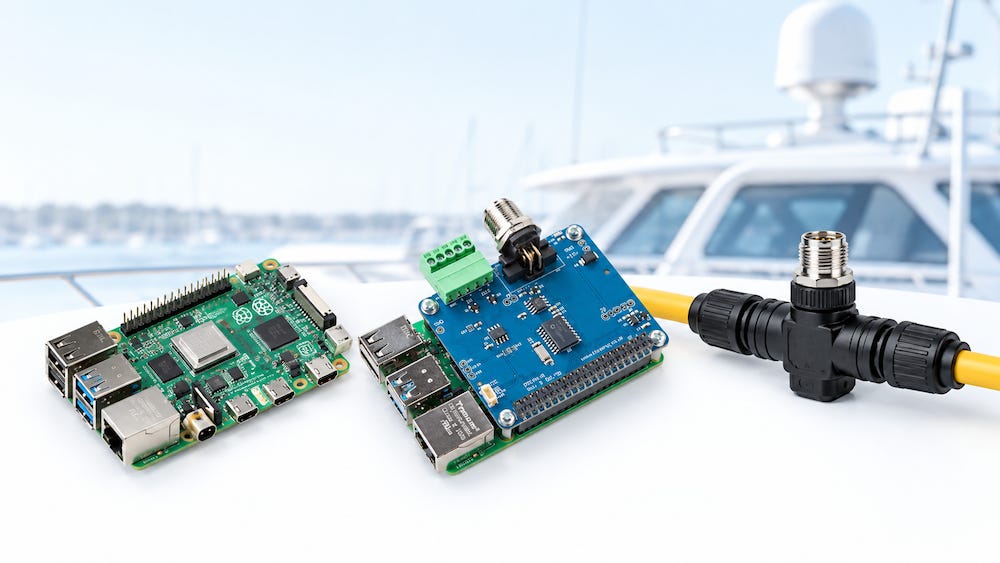
The Raspberry Pi has become an increasingly popular platform for marine applications. Combined with an NMEA 2000 interface, it can serve as a data logger, gateway, Signal K server, OpenPlotter system, or custom marine controller.
There is, however, an important difference between the Raspberry Pi 3, Raspberry Pi 4, and Raspberry Pi 5 that is easily overlooked: power consumption.
With the Raspberry Pi 5, we have reached the point where powering the complete computer directly from the NMEA 2000 network is no longer a good design choice.
NMEA 2000 Is a Data Network — With a Limited Power Budget
NMEA 2000 does more than carry CAN bus data. The backbone also distributes DC power to connected devices.
The nominal network voltage is 12 VDC, with NMEA 2000 devices designed to operate over a range of approximately 9 to 16 VDC.
Power consumption on an NMEA 2000 network is expressed using the Load Equivalency Number, or LEN:
1 LEN = 50 mA
A device drawing 250 mA from the network therefore represents 5 LEN.
According to the NMEA 2000 power model, the maximum current a single device should draw from the backbone is 1 A, corresponding to 20 LEN. Equipment requiring more power should use a separate power connection.
That limit makes sense when considering what NMEA 2000 was designed to support. A marine network may contain GPS receivers, engine interfaces, heading sensors, temperature sensors, gateways, displays, and numerous other devices. They all share the available network power.
A general-purpose computer can become a disproportionately large load on that network.
The Raspberry Pi Power Requirement Has Increased
The progression of the Raspberry Pi illustrates the problem.
Raspberry Pi recommends the following power-supply capacities:
Raspberry Pi 3: 5 V / 2.5 A
Raspberry Pi 4: 5 V / 3 A
Raspberry Pi 5: 5 V / 5 A
These numbers should not be interpreted as the amount of current the Raspberry Pi continuously consumes. Actual consumption is normally considerably lower and varies according to processor load, USB devices, storage, networking, and other peripherals.
Nevertheless, the recommended supply rating tells us something important when designing an embedded system: how much power must potentially be available for reliable operation.
The Raspberry Pi 5 represents a significant jump. Raspberry Pi recommends a 27 W USB-C power supply capable of providing 5 V at 5 A. The Pi 5 can operate from a 5 V / 3 A supply, but doing so restricts the available power for USB peripherals.
That is very different from designing a small sensor or gateway intended to obtain all of its operating power from an NMEA 2000 backbone.
The 12 V-to-5 V Conversion Matters
An NMEA 2000 network does not provide the 5 V required by a Raspberry Pi. An interface that powers the Pi from the network therefore needs a DC/DC converter, normally a switch-mode power supply (SMPS).
For example, our PiCAN-M with SMPS provides a regulated 5 V supply rated at 3 A from the marine DC input.
That arrangement works well with a Raspberry Pi 3 and can support a Raspberry Pi 4, although the Pi 4 is already approaching the capability of a 3 A supply when the system is heavily loaded.
The Raspberry Pi 5 changes the equation.
Its recommended supply is capable of 5 A. The 3 A SMPS therefore cannot provide the full power budget for which the Raspberry Pi 5 was designed.
Simply installing a larger DC/DC converter does not completely solve the problem if that converter continues to obtain its input power from the NMEA 2000 backbone.
At a theoretical maximum of 25 W for a 5 V / 5 A supply, a converter operating from approximately 12 V would need more than 2 A on its input side after conversion losses. That is already well beyond the 1 A maximum normally allocated to a single NMEA 2000-powered device.
In other words, the problem moves from the 5 V side to the 12 V side.
Raspberry Pi 3, 4, and 5 in Practical NMEA 2000 Systems
The Raspberry Pi 3 remains relatively comfortable in applications where the Raspberry Pi and NMEA 2000 interface are powered through a suitably designed DC/DC converter. Its actual operating consumption is modest compared with later Raspberry Pi generations.
The Raspberry Pi 4 increased the available computing power and the corresponding power requirement. It can still work with a 5 V / 3 A supply, but there is considerably less power margin, particularly when USB devices and other peripherals are attached.
The Raspberry Pi 5 takes another substantial step in performance — and power requirements. Designing an NMEA 2000 interface around the assumption that the network will also provide the full operating power for the Pi 5 is therefore difficult to justify.
The Better Solution: Separate the Computer Power from the Network
Fortunately, there is nothing preventing a Raspberry Pi 5 from being used with NMEA 2000.
The better approach is simply to separate the two power requirements.
The Raspberry Pi 5 should receive its main power from an appropriately rated external DC/DC converter or USB-C power supply connected to the vessel’s electrical system. The NMEA 2000 interface remains connected to the NMEA 2000 backbone for CAN communication.
This is similar to the way many larger marine displays and multifunction devices operate. They communicate over NMEA 2000 but obtain their primary operating power separately rather than expecting the network backbone to power the entire device.
For a Raspberry Pi 5, this architecture provides several advantages. It prevents a computer-class load from consuming a large portion of the NMEA 2000 power budget, provides adequate current for processor peaks and USB peripherals, reduces the possibility of Raspberry Pi undervoltage conditions, and avoids unnecessary voltage drop along the NMEA 2000 backbone.
More Computing Power Requires a Different Power Strategy
The Raspberry Pi 5 is an excellent platform for marine computing. Its substantially higher performance makes it particularly attractive for Signal K, OpenPlotter, data logging, dashboards, and more demanding onboard applications.
The issue is not NMEA 2000 compatibility. From the CAN communication perspective, there is no fundamental reason why a Raspberry Pi 5 cannot participate in an NMEA 2000 network.
The issue is power.
Earlier Raspberry Pi generations were much easier to treat like embedded devices that could obtain their operating power through a marine interface board. With the Raspberry Pi 5, the safer engineering approach is to regard the Raspberry Pi as a small onboard computer: connect it to NMEA 2000 for communication, but provide its primary power independently.
That small distinction can make the difference between an installation that merely works on the bench and one that remains reliable aboard a vessel.