


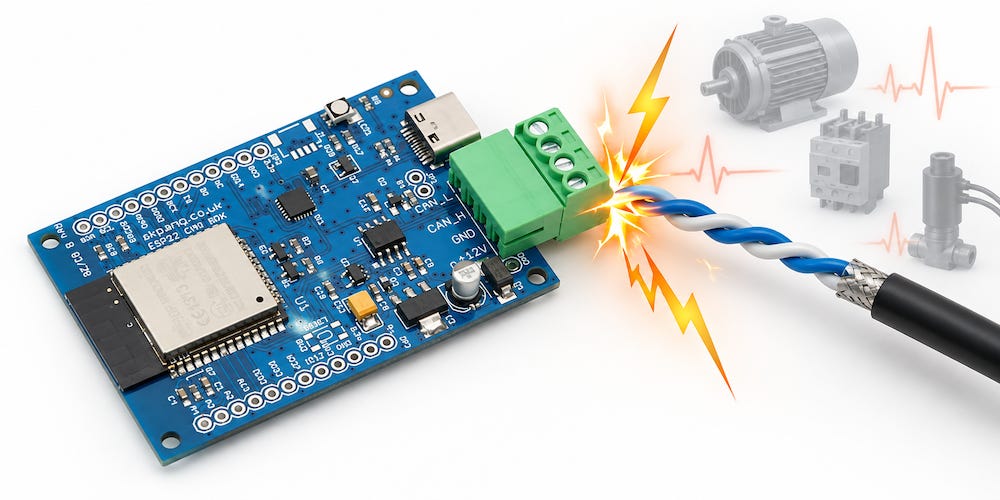
A customer contacted me recently because he was having a recurring problem with one of our CAN boards. A diode on the board kept failing. He knew which component was causing the problem, but he didn’t know why it kept happening.
The component in question is a PESD1CAN-U connected to CAN_H and CAN_L. Its job is simple: protect the CAN interface against electrostatic discharge (ESD) and other voltage transients.
Under normal CAN operation, this diode shouldn’t have much to do. It sits there waiting for something abnormal to happen. If a voltage spike appears on one of the CAN lines, the diode clamps the transient and helps prevent that energy from reaching the CAN transceiver.
If that diode fails repeatedly, therefore, replacing it may get the board running again, but it doesn’t address the real problem.
Something is happening on the CAN bus.
ESD Is One Possibility—but Not the Only One
The immediate explanation for a failed ESD protection diode is, naturally, ESD. And that certainly can be the cause.
But I wouldn’t automatically assume that somebody is walking across a carpet and touching the CAN connector.
In an industrial or automotive environment, CAN wiring can be exposed to all sorts of electrical transients. Motors, relays, solenoids, contactors, pumps, and other inductive loads can generate substantial voltage spikes. Long CAN cables can also pick up electrical noise, particularly when they are routed alongside power wiring.
Another issue I would look at very closely is grounding.
CAN is a differential bus, which makes it quite resistant to electrical noise. But that doesn’t mean it is immune to differences in ground potential between connected devices. If two CAN nodes are referenced to significantly different ground potentials, CAN_H and CAN_L can be pushed outside the common-mode voltage range that the interface was designed to tolerate.
At that point, the protection circuitry may start doing exactly what it was designed to do—and if the transient energy is high enough or occurs often enough, the protection diode can eventually fail.
What Should You Check?
If I encountered this problem in an installation, I would start with the basics.
Check the CAN wiring and, especially, the grounding between the connected devices. Look for equipment that could be producing electrical transients, particularly motors, relays, solenoids, and other inductive loads. Also look at how the CAN cable is routed. Running a CAN cable alongside high-current power wiring is generally something I would avoid.
The cable itself is worth considering as well. CAN_H and CAN_L should be carried as a twisted pair. In an electrically noisy environment, a properly installed shielded twisted-pair CAN cable can provide additional protection against interference picked up along the cable.
However, I wouldn’t consider shielding a cure for a grounding problem. If there is a significant ground-potential difference between CAN nodes, adding a shield isn’t going to make that problem disappear.
The Failed Diode Is Telling You Something
This is really the interesting part of the problem.
When a protection diode repeatedly fails, it’s tempting to view the diode as the problem. In reality, the diode may simply be providing useful evidence of a problem somewhere else in the system.
It is there to protect the CAN interface from abnormal electrical conditions. If it keeps getting destroyed, something on the CAN bus is repeatedly exceeding what that protection circuit can safely handle.
Replacing the diode fixes the symptom.
Finding the source of those transients fixes the problem.