


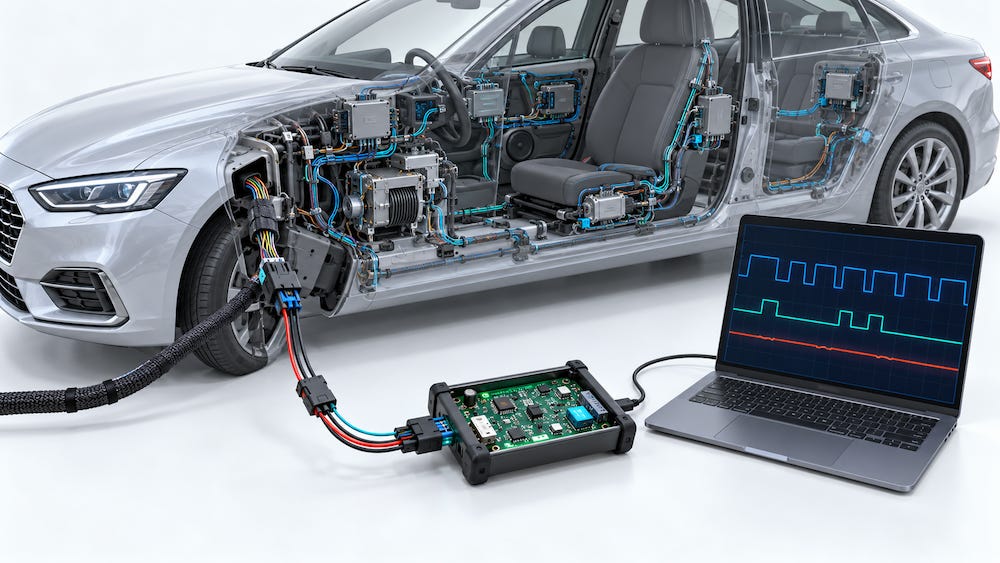
After writing my previous post comparing CAN Bus and LIN Bus, I became curious about a practical question: If LIN connects sensors, switches, and actuators throughout a vehicle, could I connect my own hardware and interact with those devices? My background in CAN Bus and SAE J1939 made the idea particularly interesting. Reading sensor values, adding a custom control, or operating an existing actuator all sound like worthwhile projects. However, LIN’s inexpensive hardware and relatively simple communication protocol do not automatically make an existing vehicle network easy to modify.
Connecting Is Only the Beginning
Tapping into a LIN network can mean several different things. It might involve passively recording messages, interpreting sensor readings, simulating a missing device, or actively changing how a subsystem operates. These activities have very different requirements.
Observing communication is generally the least intrusive starting point. A suitable interface can receive traffic without deliberately transmitting onto the bus. Active participation requires a much deeper understanding of the network, because your hardware must transmit the correct information at the correct time.
Before either activity, you need to identify the actual LIN connection. A device’s function alone does not reveal its interface. A motor might connect directly to a controller, while that controller communicates over LIN or CAN. Likewise, a nearby LIN wire may belong to a different group of devices than the one you want to investigate.
The Appeal: Inexpensive Hardware and Useful Access
LIN offers an attractive starting point for embedded development. A microcontroller with a suitable UART or LIN peripheral, together with a LIN transceiver, can provide the basic communication hardware. An ordinary USB-to-serial adapter alone is insufficient because its electrical interface does not match the automotive LIN bus.
The potential applications extend well beyond operating a particular actuator. A developer might investigate a switch panel, record temperature sensor readings, study a climate-control subsystem, or build a test fixture for a removed automotive component.
This access can be especially useful on the workbench. Instead of installing an entire vehicle subsystem, a developer can provide power and emulate the communication needed by an individual device. Once its requirements are understood, that arrangement can support troubleshooting, demonstrations, and component testing.
The First Obstacle: Understanding the Messages
LIN defines how information travels, but it does not provide a universal command set for every connected device.
A frame identifier and several data bytes do not explain themselves. Those bytes might represent a requested position, a measured temperature, switch states, operating modes, or several signals packed together. Their meaning depends on the particular application.
The most useful starting point is the correct LIN Description File, commonly called an LDF. It describes the network’s frames, signals, publishers, subscribers, and schedules. Even with that file, additional application documentation may be needed to understand operating conditions or device behavior.
Without documentation, investigation becomes a process of observation and comparison. You record traffic while changing one known input at a time, then look for corresponding changes in the messages. This can reveal useful relationships, but a changing byte is only a clue. It may be a command, feedback, a counter, or an unrelated value.
The Second Obstacle: LIN Has a Commander
LIN communication follows a schedule managed by one commander, traditionally called the master. The commander transmits a frame header, and the designated publisher provides the response. Depending on the frame, the publisher may be the commander itself or another node.
That structure matters when adding custom hardware. You cannot assume that a newly connected device may transmit whenever it has something to say. The existing network already assigns responsibility for each frame.
If your controller sends headers while the original commander is operating, their transmissions can overlap. If it supplies a response already assigned to another device, both may transmit simultaneously. LIN does not use CAN’s priority-based arbitration to resolve that competition.
Consequently, understanding a command is only part of the task. You must also determine how your hardware can transmit it without conflicting with the existing participants.
Listening, Replacing, and Modifying
There are three broadly useful approaches, each with its own advantages and limitations.
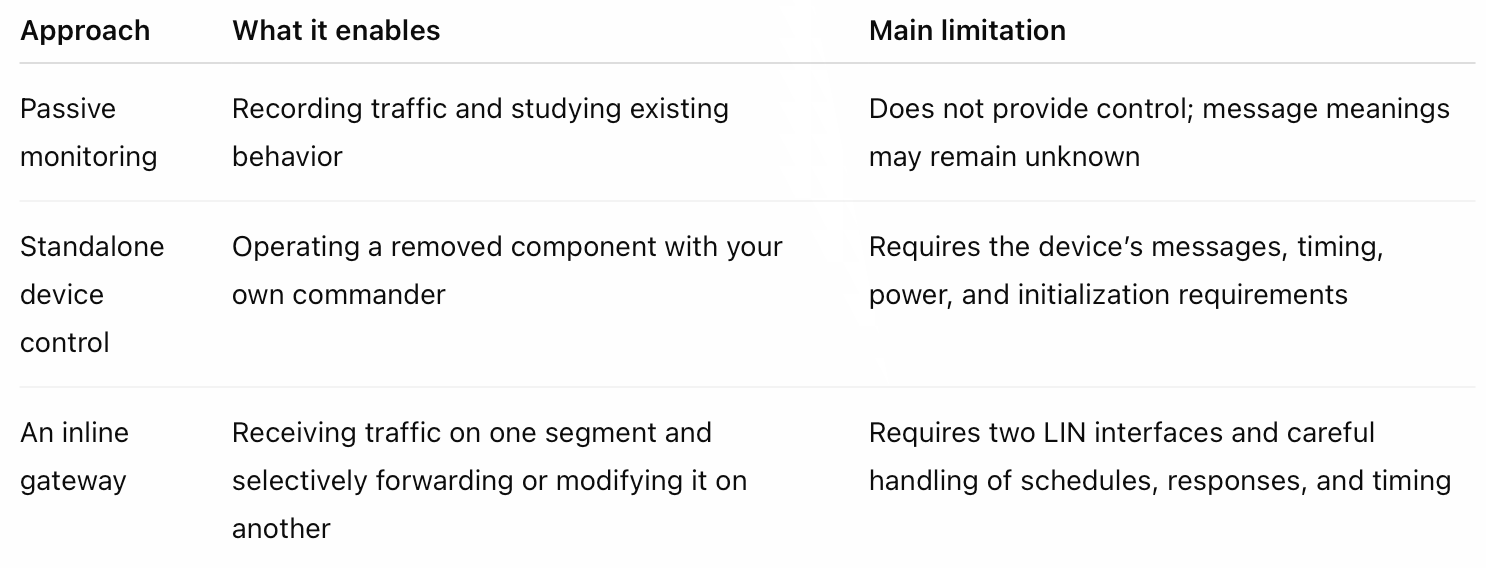
Passive monitoring is a sensible first step because it establishes what the original system actually does.
Standalone operation provides greater freedom. With the original commander disconnected, your controller can manage the schedule. However, some components may expect initialization, configuration, or repeated communication before they operate.
An inline gateway offers more flexibility within an existing installation, but it is substantially more demanding. It creates separate electrical segments and must fulfill the appropriate communication role on each side. It must also preserve the behavior that the original controllers expect.
Why Replaying a Captured Message May Fail
Capturing a message during a particular action can make replay seem like an obvious next step. Sometimes it works, especially in a simple bench setup. In other cases, the captured message is only one part of a larger exchange.
A device may require a wake-up sequence, an operating-mode command, or periodic updates. The message you recorded might report an action rather than request it. Some applications also include counters or additional validity checks.
Even a valid command may have only a temporary effect if the original controller sends a different value during the next scheduled cycle.
Successful control therefore requires an understanding of the device’s ongoing conversation, including what happens before, during, and after the desired action.
Electrical Simplicity Still Requires Care
LIN’s single communication wire simplifies the network, but that wire is part of an automotive electrical system. A suitable transceiver provides the interface between the bus and the microcontroller’s logic signals. Power, grounding, and protection remain part of the design.
The interface’s operating mode also matters. Equipment intended only to observe traffic should not accidentally transmit, wake sleeping devices, or apply an inappropriate commander pull-up arrangement.
Sleep behavior deserves particular attention in an installed vehicle. A custom device that repeatedly wakes a LIN branch—or prevents it from sleeping—can keep other electronics active and increase battery consumption.
These issues are manageable, but they illustrate why a successful bench experiment is only one step toward a dependable vehicle installation.
Where the Effort Pays Off
Tapping into LIN is particularly rewarding when the objective is specific and the relevant documentation is available. Recording a known signal, testing a documented actuator, or emulating a defined node can be a practical embedded project.
The effort increases considerably when both the message definitions and the operating sequence are unknown. At that point, much of the work involves discovering the manufacturer’s application behavior rather than implementing LIN itself.
That distinction is the most useful lesson from my curiosity. LIN makes inexpensive automotive networking possible, and it offers interesting opportunities for independent development. Accessing an existing network, however, requires more than an electrical connection. The useful information lies in the messages, the schedule, and the behavior of the devices exchanging them.