


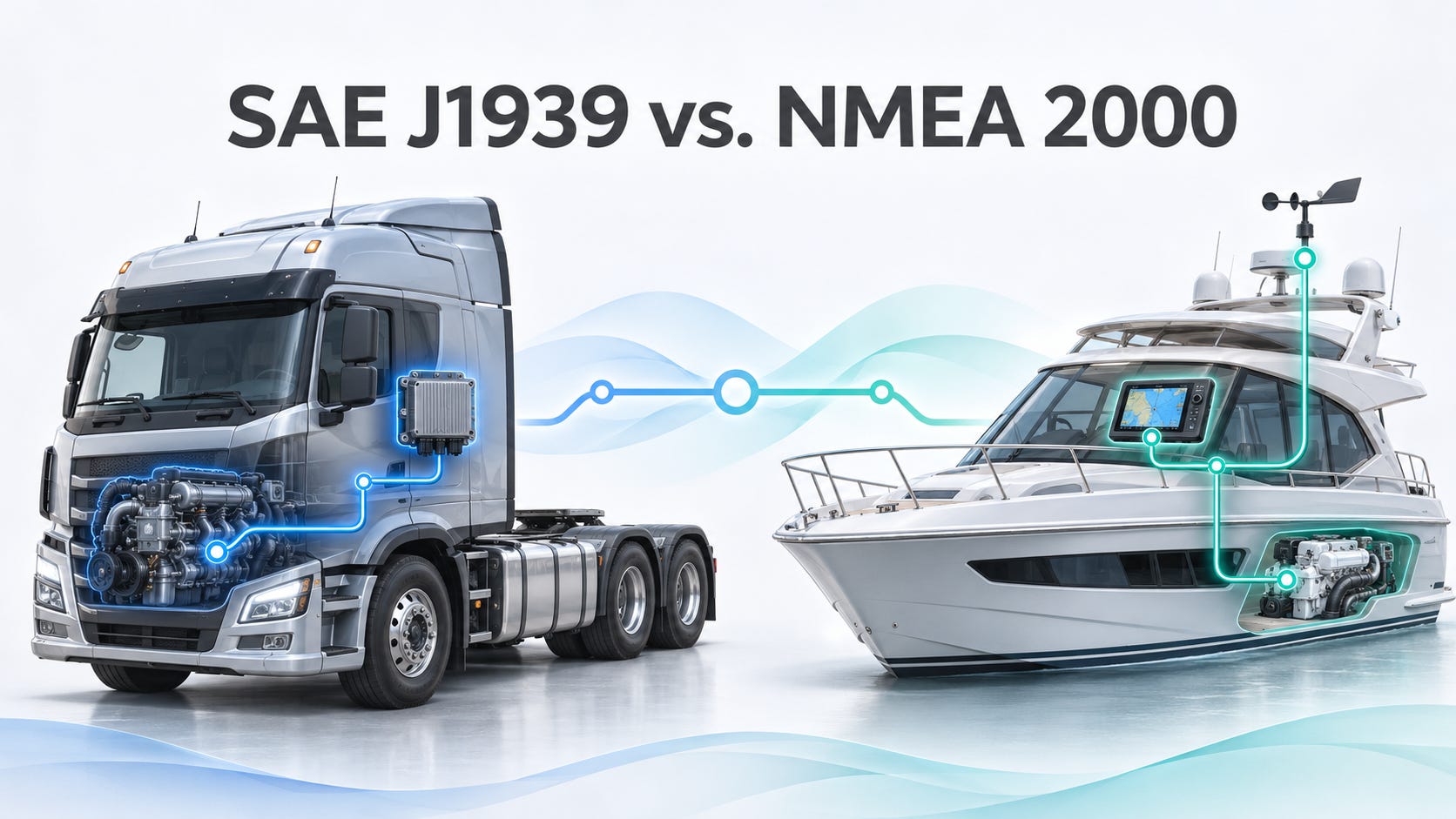
If you are familiar with SAE J1939, your first encounter with NMEA 2000 may look surprisingly familiar. There are CAN messages, 29-bit identifiers, source addresses, and Parameter Group Numbers. Much of the underlying structure seems to be the same.
That resemblance is no coincidence. NMEA 2000 belongs to the same protocol family, drawing on the J1939-based communication framework used in ISO 11783. However, calling it “J1939 for boats” leaves out several differences that matter when connecting equipment, developing software, or interpreting recorded data.
For me, the most useful way to understand the relationship is to separate three questions: How does the data travel? What does it mean? And what must a device do to participate in the network?
CAN provides the foundation
CAN Bus provides the underlying communication technology. It handles tasks such as transmitting frames, resolving competition for bus access, and detecting transmission errors. It does not, by itself, explain whether a particular data byte represents engine speed, water depth, or battery voltage.
That interpretation belongs to the higher-layer protocol.
SAE J1939 and NMEA 2000 both use extended CAN identifiers containing 29 bits. Their related identifier structures carry information such as message priority, source address, and the information used to determine the Parameter Group Number, usually abbreviated PGN. This common structure is one reason J1939 experience transfers well to NMEA 2000 development.
The important distinction is that recognizing the structure of a message does not necessarily mean understanding its contents.
Different equipment, different information
SAE J1939 is widely used for communication and diagnostics in diesel engine systems, including those found in trucks, buses, agricultural and construction machinery, trains, ships, and stationary generators. It allows engines, transmissions, and other electronic control units to exchange operating data, commands, and diagnostic information. Although its scope extends beyond diesel engines, this association helps explain why J1939 also appears aboard vessels: the distinction between J1939 and NMEA 2000 concerns their roles and message definitions, rather than simply trucks versus boats.
NMEA 2000 focuses on integrating marine equipment. Its scope includes navigation instruments, GNSS receivers, wind sensors, propulsion systems, batteries, lighting, and other vessel systems. A chartplotter, for example, may receive information from several independent devices through the same network.
This difference in purpose shapes the information each standard defines. A vehicle controller and a marine navigation display may both need engine information, but the navigation display also needs information that has little relevance to a truck.
A PGN identifies a message—not a universal data format
Both protocols organize information into parameter groups identified by PGNs. However, their application message definitions are different.
To interpret a message correctly, software must know the applicable PGN definition, the location of each field, its resolution, its units, and any special values indicating unavailable or invalid information.
This is where a common misconception arises: a program that extracts a PGN from an NMEA 2000 CAN identifier has not automatically decoded the marine data. It has identified the message category. Understanding the payload requires the appropriate NMEA 2000 definitions.
For example, NMEA 2000 defines PGN 127488 as “Engine Parameters, Rapid Update.” A marine display expecting this message will not automatically obtain the same information from an unrelated J1939 engine message merely because both travel over CAN. Garmin’s J1939 bridging documentation explicitly lists the NMEA 2000 engine and other PGNs it can make available through bridging.
Messages longer than eight bytes
A Classical CAN frame carries no more than eight data bytes. Both protocols therefore need a way to transmit information that will not fit into one frame.
Traditional SAE J1939 uses the transport protocol (TP) defined in J1939/21. It divides longer messages into multiple frames and uses transport management messages to coordinate their transmission. Depending on the transfer method, communication can involve a broadcast announcement or an exchange between a sender and a receiver.
NMEA 2000 adds a mechanism called Fast Packet. It carries a longer parameter group across several CAN frames while retaining the original PGN in their identifiers. Fast Packet supports messages containing up to 223 bytes.
This matters when selecting monitoring software. A tool may capture every CAN frame correctly while leaving a Fast Packet message scattered across several display lines. Capturing the frames and reconstructing the complete message are separate capabilities.
Protocol differences beyond Fast Packet
Fast Packet is the most visible addition to the message transport mechanisms, but the differences extend further. Although SAE J1939 and NMEA 2000 share the basic 29-bit identifier structure, PGN addressing, and address-claiming foundation, NMEA 2000 adds or specializes several aspects:
Message definitions: Marine PGNs specify their own data fields, units, resolutions, and special values indicating unavailable or invalid information.
Network services: NMEA 2000 defines services for identifying products, reporting supported transmit and receive PGNs, and configuring devices.
Group functions: These provide standardized mechanisms for requesting information, commanding supported parameter changes, and acknowledging requests. Depending on device capabilities, they can also configure message transmission intervals.
Device identity: NMEA 2000 uses marine-specific device classes, functions, and instance conventions within the shared identification framework.
Required device behavior: NMEA 2000 specifies its own requirements for startup, responses to requests, and the transmission of mandatory information.
Consequently, adding Fast Packet support to a J1939 implementation addresses only part of the work. A complete NMEA 2000 implementation must also handle the applicable marine messages, network services, and device behavior.
Network speed and installation
NMEA 2000 operates at 250 kbit/s. Classical J1939 networks commonly operate at either 250 or 500 kbit/s, depending on the applicable physical-layer specification. Matching the bit rate is therefore an essential first step when attempting to monitor either network.
NMEA 2000 also provides a standardized installation approach built around a backbone, drop cables, connectors, and network power. Devices connect along the backbone, with termination at its two ends. These installation requirements are part of creating a predictable marine network, rather than leaving every equipment manufacturer to invent its own wiring arrangement.
An electrically suitable CAN interface may therefore be useful for development, but connecting it requires more thought than finding CAN High and CAN Low. Connector pin assignments, power connections, termination, and the interface’s electrical design all deserve attention.
Address claiming is shared territory
NMEA 2000 is designed to support a self-configuring network containing equipment from different manufacturers. Device identification and address management contribute to that behavior.
However, it would be misleading to say that NMEA 2000 supports address claiming while SAE J1939 does not. J1939/81 explicitly defines address selection and address claiming. The actual addressing behavior depends on the device and its implementation.
For developers, the lesson is straightforward: understanding J1939 network management provides a useful foundation, but an NMEA 2000 device must still satisfy the marine standard’s specific requirements.
Can a J1939 monitor read NMEA 2000?
At the raw CAN level, a suitable interface can capture NMEA 2000 traffic if it supports extended identifiers, operates at 250 kbit/s, and is connected correctly. A J1939-oriented monitor may also be able to display useful information such as source addresses, priorities, PGNs, and data bytes because of the related message structure.
That can be valuable for checking whether traffic is present, identifying transmitting devices, or recording messages for later examination.
Displaying meaningful marine measurements requires additional support: NMEA 2000 message definitions, the appropriate decoding logic, and Fast Packet reassembly where applicable. This follows directly from the distinction between the shared CAN structure and the additional NMEA 2000 protocol features.
I would therefore distinguish between monitoring NMEA 2000 traffic and providing a complete NMEA 2000 analyzer. Both can be useful, but they answer different questions.
Connecting the two networks
A marine engine may provide J1939 data while the vessel’s instruments communicate through NMEA 2000. A gateway can connect these systems by translating supported engine information into the messages expected by the marine equipment.
The gateway must understand the data on both sides. Simply changing the connector does not perform that translation. Furthermore, a gateway may support only selected parameters; proprietary engine information may remain unavailable to the NMEA 2000 display.
Product development goes beyond receiving messages
For a commercial product, NMEA 2000 development also involves licensing and certification requirements. NMEA specifies certification for products that read or transmit NMEA 2000 information, with testing intended to support interoperability.
SAE J1939 has its own network compliance document, J1939/82. Nevertheless, implementing a J1939 protocol stack does not, by itself, establish NMEA 2000 compliance.
The shared foundation makes NMEA 2000 approachable for someone with J1939 experience. Familiar concepts remain useful, and some CAN hardware and software components can be reused. The remaining work lies in understanding the marine messages, handling their transfer methods, and meeting the requirements of the network they serve.