


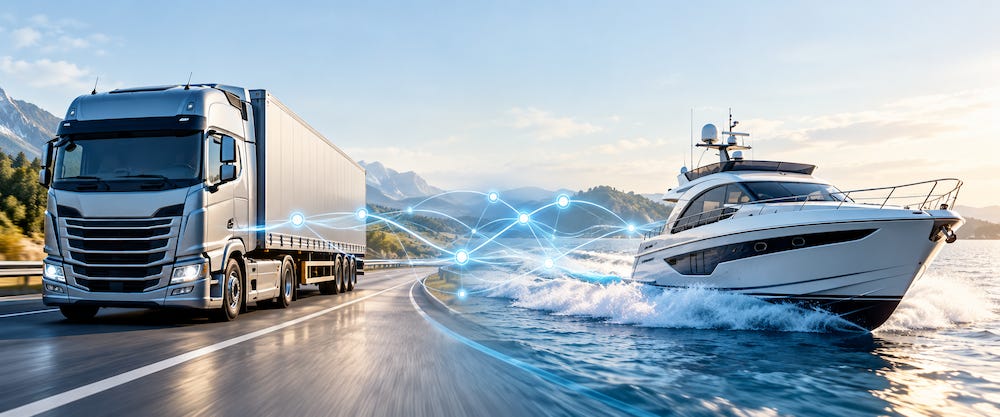
I have spent a good part of my professional life working with SAE J1939. I have written books about it, developed my own protocol stack and diagnostic software for it, and designed hardware around it. So, yes, I admit to having a certain affection for J1939.
NMEA 2000 is a different story.
I have worked with it, and my business Copperhill Technologies is a member of the National Marine Electronics Association (NMEA), but I never immersed myself in NMEA 2000 to the same degree. That may sound a little surprising because, from a CAN Bus engineer’s perspective, the two protocols have a great deal in common.
And that is exactly what makes the comparison interesting.
They Speak a Very Similar Language
At the lowest level, both SAE J1939 and NMEA 2000 are CAN-based higher-layer protocols. They use concepts that will immediately look familiar to anyone who has worked with J1939: 29-bit CAN identifiers, Parameter Group Numbers (PGNs), source addresses, network management, and standardized messages.
SAE describes J1939 as an architecture intended to allow electronic control units to communicate with one another, particularly in heavy-duty vehicles, agricultural and construction equipment, and related applications.
NMEA describes NMEA 2000 as a CAN-based, multi-master, self-configuring network for interconnecting marine electronic equipment. Its devices exchange information through PGNs, just as we encounter in the J1939 world.
Consequently, if you already understand J1939, your first encounter with NMEA 2000 can produce a pleasant sense of familiarity.
You are not starting from zero.
The Application Is Where the Roads Separate
J1939 grew primarily around commercial vehicles and machinery. Engines, transmissions, brakes, vehicle controllers, diagnostic systems, agricultural machinery, construction equipment, and generator sets are typical territory.
NMEA 2000 lives on boats.
Its standardized messages consequently deal with an entirely different collection of information: navigation, GNSS, AIS, wind, depth, environmental data, battery systems, propulsion, vessel controls, lighting, HVAC, entertainment systems, and many other functions found aboard modern vessels.
The basic networking ideas may therefore look familiar while the application layer feels quite different.
An engine speed is still an engine speed. A temperature is still a temperature. But once we start talking about heading, rate of turn, water depth, wind data, waypoints, AIS targets, or navigation information, we have clearly left the truck behind and stepped onto the boat.
J1939 Always Felt More Accessible to Me
There is another difference, however, and this one has probably influenced my own relationship with the two standards more than the technical details.
J1939 has always felt relatively accessible to me as a developer.
That does not mean the complete SAE J1939 documentation is free. It isn’t. J1939 consists of numerous SAE documents, and important information such as PGN and parameter assignments is maintained in the J1939 Digital Annex.
Nevertheless, the protocol has developed an enormous ecosystem around it. There are books, development tools, CAN interfaces, example programs, open-source projects, technical discussions, and decades of accumulated engineering knowledge.
That environment encourages experimentation.
Buy a CAN interface, connect two nodes on a workbench, send a 29-bit CAN message, decode a PGN, implement Address Claim, make a mistake, fix it, and keep going.
That is very much how I learned J1939, and probably one reason I still enjoy working with it.
NMEA 2000 Has a More Controlled Ecosystem
My experience with NMEA 2000 has been different.
The NMEA 2000 specification is intellectual property of the National Marine Electronics Association and is distributed under a licensing structure. Access to the standard and updates depends on the type of organization and membership status. NMEA also distinguishes between marine manufacturers, non-marine companies, and associate members.
Copperhill Technologies is an NMEA member, so I have had access to that ecosystem. Even so, entering NMEA 2000 development involves a considerably more formal framework than simply deciding to build another CAN Bus device.
And purchasing the specification represents a significant investment, particularly for a small developer who merely wants to explore the technology.
There is also an important distinction between creating something that happens to communicate using NMEA 2000 messages and marketing a product as an officially certified NMEA 2000 product.
NMEA requires products that read or transmit NMEA 2000 information to be certified. Manufacturers obtain an NMEA manufacturer code, certified products receive product codes, and certification involves testing and submission to NMEA. Only after successful certification can the official NMEA 2000 logo and the designation “NMEA 2000 Certified” be used in product marketing.
From an industry perspective, I understand the reasoning.
Marine electronics from different manufacturers are expected to coexist on the same vessel. A chartplotter from one manufacturer may need to communicate reliably with an engine interface, GPS receiver, autopilot, depth sounder, or sensor made by somebody else. Certification provides a level of assurance that everyone has followed the same rules.
From the perspective of a small developer who likes to experiment, however, it creates a noticeably higher threshold for entry.
Similar CAN Frames Do Not Make Them Interchangeable
This is also where an important misconception can arise.
Knowing J1939 does not automatically mean that you know NMEA 2000.
The shared CAN foundation and familiar concepts certainly shorten the learning curve. When I first look at an NMEA 2000 message, I am seeing familiar building blocks rather than an entirely foreign protocol.
But implementing a compliant network device involves considerably more than recognizing a PGN inside a 29-bit CAN identifier.
The application definitions are different. The physical-network requirements are different. Device behavior and certification requirements matter. The NMEA 2000 PGN database contains messages specifically designed around marine applications, and NMEA places considerable emphasis on interoperability between certified products.
So I would describe NMEA 2000 not simply as “J1939 for boats.” That description is tempting, and as a first approximation it even helps explain the family resemblance.
But it doesn’t tell the whole story.
Why I Still Prefer Working With J1939
Part of this is simply familiarity.
After so many years with J1939, I can look at a CAN identifier or a hexadecimal data field and usually have a pretty good idea of what is happening. I know where the traps are. I know which parts of the documentation deserve a second reading. And, perhaps most importantly, I still enjoy working with it.
There is something wonderfully practical about J1939.
Connect a few ECUs, watch the traffic, identify the PGNs, decode the data, and suddenly a machine that appeared silent begins telling you exactly what it is doing.
NMEA 2000 offers much of the same fascination. A modern boat is essentially another distributed embedded-control system, only with very different surroundings and requirements.
Perhaps that is why I continue to be interested in NMEA 2000 even though I have never gone as deeply into it as I have with J1939.
Technically, it feels like visiting a relative.
You recognize the family immediately.
But after sitting down and talking for a while, you realize that the two have led very different lives.
For additional information about the standards themselves, see the official NMEA 2000 information and SAE J1939 documentation.