


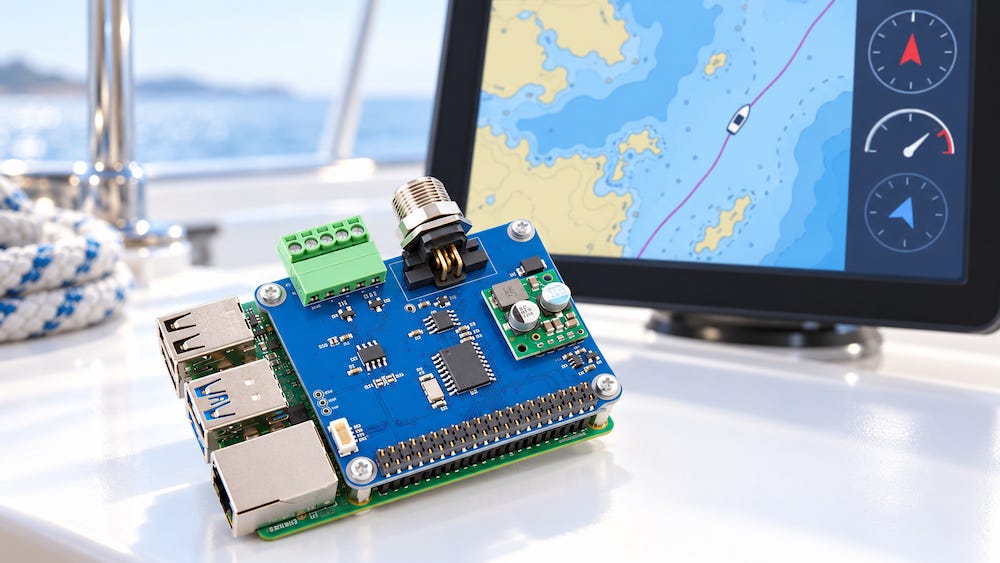
Connecting a Raspberry Pi to a boat’s NMEA 2000 network opens the door to useful applications, from data logging and engine monitoring to Signal K dashboards and OpenPlotter projects. The PiCAN-M HAT, available from Copperhill Technologies, provides the marine interfaces needed for these projects.
However, reliable communication starts with reliable power. Choosing a power supply involves more than checking whether the Raspberry Pi boots successfully. The installation must meet the computer’s power requirements while respecting the current limits of the NMEA 2000 network.
Those are two different requirements, and the distinction matters for Raspberry Pi versions 3, 4, and 5.
What the PiCAN-M HAT Provides
The PiCAN-M HAT provides an NMEA 2000 connection through a Micro-C connector and an NMEA 0183 RS422 interface through a screw terminal. Its SocketCAN support allows Linux applications to access the CAN interface, making it useful for marine development, diagnostics, and onboard monitoring.
The board is available with or without an onboard switched-mode power supply, commonly abbreviated as SMPS.
Without the SMPS, the Raspberry Pi receives power from a separate supply and powers the HAT through its header. This arrangement works well when the installation already includes a suitable regulated supply for the computer.
The SMPS version draws power from the nominal 12 V NMEA 2000 network and converts it to a 5 V supply rated for up to 3 A, shared by the Raspberry Pi and HAT. This reduces wiring and can eliminate a separate converter.
However, the converter’s 3 A output rating does not mean the installation is permitted to draw 3 A from the NMEA 2000 backbone.
Understanding NMEA 2000 Current Limits
NMEA 2000 uses a nominal 12 VDC supply. Network power consumption is expressed through a Load Equivalency Number, or LEN:
1 LEN represents 50 mA of current drawn from the network.
20 LEN represents 1 A.
A device requiring more than 1 A from the backbone needs a separate power supply.
These values apply at the NMEA 2000 connection, before conversion to the Raspberry Pi’s 5 V supply. Actisense’s network power guidance explains this relationship and the individual-device limit.
The 1 A limit does not describe the capacity of the entire backbone. Total network capacity depends on the cables, connectors, power feeds, protection, and voltage drop. Nevertheless, spare capacity elsewhere in the network does not remove the limit for an individual device.
This creates two separate checks for a PiCAN-M installation: Can the converter supply the complete 5 V load, and can it do so without exceeding the permitted backbone draw?
Raspberry Pi 3, 4, and 5: Different Power Budgets
Raspberry Pi’s official power recommendations specify the following supply capacities:

These are recommended power-supply ratings, not constant consumption figures. Actual demand depends on processor activity, storage, cooling, connected peripherals, and other hardware.
Raspberry Pi 3
The Pi 3’s recommended 2.5 A supply capacity falls below the PiCAN-M converter’s 3 A rating. From the converter-output perspective, this makes it a reasonable candidate for modest marine gateway applications, provided the HAT’s consumption is included.
However, that does not automatically establish suitability for backbone power. The complete system’s maximum network current must also remain within the NMEA 2000 limit.
Raspberry Pi 4
The Pi 4’s recommended 3 A supply capacity matches the onboard converter’s maximum output rating. At that output level, there is no additional rating margin for the HAT.
A lightly loaded Pi 4 may consume substantially less, but attached USB devices and other accessories can change the power budget. The installation must therefore be evaluated as a complete system.
Raspberry Pi 5
The Pi 5 increases the recommended supply capacity to 5 A, exceeding the onboard SMPS rating.
There is an important qualification: the Pi 5 can operate from a suitable 5 V, 3 A USB-C supply, with USB peripheral current restricted to 600 mA. A recognized 5 A supply enables a larger peripheral power budget.
Consequently, saying that the Pi 5 always draws or requires 5 A would be inaccurate. Nevertheless, the PiCAN-M’s shared 3 A supply cannot support the full recommended Pi 5 power budget.
For a Pi 5 marine installation, I recommend a dedicated supply.
Why Comparing Amperes Alone Is Misleading
The Raspberry Pi operates at 5 V, while the NMEA 2000 backbone operates at nominally 12 V. Current values cannot be compared directly across those voltages.
The useful starting point is power:
Power = Voltage × Current
Allowing for converter losses, the approximate input current is:
Input current = Output power ÷ (Input voltage × Efficiency)
For example, assume a 12 V input and 90 percent converter efficiency:

These are calculated examples at the listed loads. They are not measured Raspberry Pi consumption figures or declared PiCAN-M LEN ratings. The 5 A example describes the demand on a larger converter; the onboard 3 A SMPS cannot deliver that output.
All three examples exceed the 1 A individual-device limit at the network connection.
This explains why even a Pi 3 cannot be assumed suitable for backbone power merely because its recommended supply rating fits within the converter’s output rating.
At 12 V and 90 percent efficiency, a 1 A input provides approximately 10.8 W at the converter output. That corresponds to about 2.16 A at 5 V, shared by the Raspberry Pi and HAT. At lower backbone voltage, the available output power decreases further.
A modest gateway may operate below that level. The design still needs to account for maximum expected consumption, startup demands, peripheral activity, and converter losses.
Installing an External Power Supply
An external power supply provides a practical solution when the computer’s power requirements exceed the onboard supply or the permitted network load. This is especially relevant for the Raspberry Pi 5.
The arrangement is straightforward: connect a suitable external power supply to the Raspberry Pi’s power input while retaining the PiCAN-M connection for NMEA 2000 communication. The computer then receives its operating power independently of the backbone.
For a Pi 5, use a supply that supports its recommended 5 V, 5 A power budget and accommodates the complete computer, HAT, cooling, and peripheral load. The official Raspberry Pi 27 W USB-C power supply is a suitable choice where an appropriate AC source is available. For other supplies, verify explicit Raspberry Pi 5 compatibility and support for 5 A delivery at 5 V.
A generic USB-C supply advertised as “30 W” does not necessarily provide 5 A at 5 V. Its maximum wattage may be available only at a higher output voltage.
The PiCAN-M version without SMPS provides a straightforward starting point for this arrangement. When adapting an existing SMPS-equipped board, obtain the correct procedure for disabling or disconnecting its regulator output before introducing another supply. Two independent regulator outputs should not simply be connected together.
The external supply removes the computer’s main power demand from the NMEA 2000 backbone while preserving the marine communication interface.
Choosing the Right Power Arrangement
For a modest Raspberry Pi 3 gateway, the onboard SMPS may be practical when the complete system’s maximum backbone draw remains within the permitted limit and the network power budget supports it.
A Raspberry Pi 4 requires closer evaluation because its recommended supply capacity already matches the converter’s maximum output rating.
For a Raspberry Pi 5, a dedicated supply is the approach I would choose. It provides a more suitable power budget for the computer and its peripherals while reducing the load placed on the marine network.

The PiCAN-M HAT from Copperhill Technologies provides a useful bridge between Raspberry Pi software and onboard instruments. Selecting the right power arrangement helps that interface deliver dependable service as the rest of the system grows.