


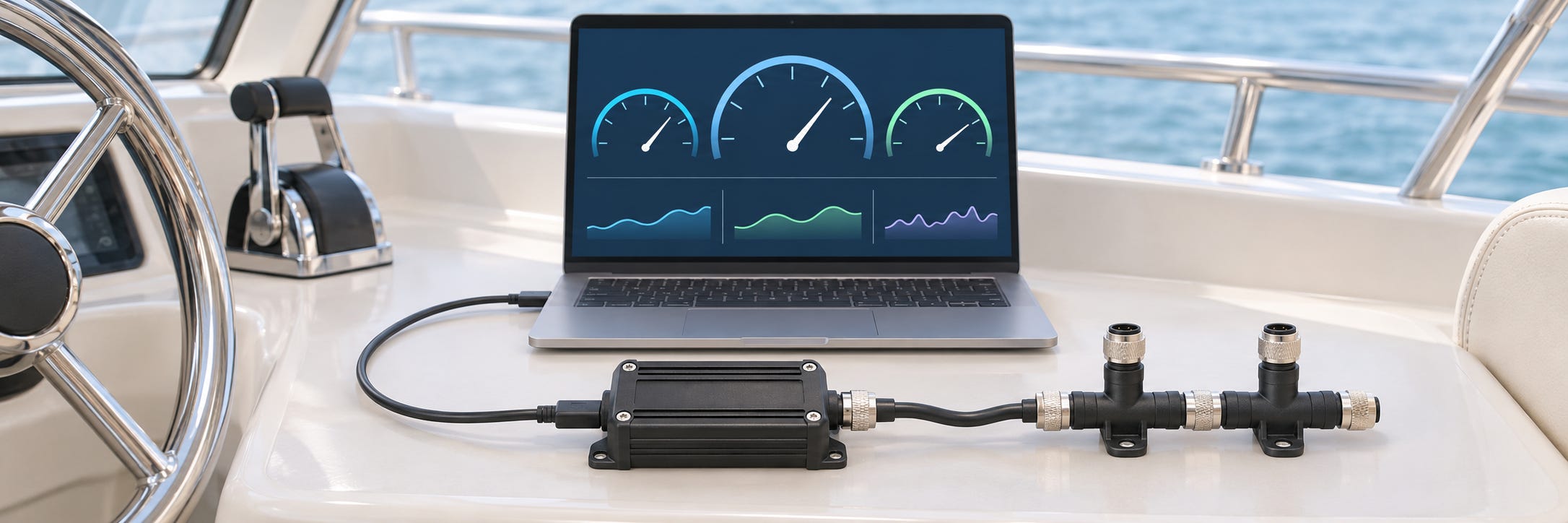
Plug an NMEA 2000 gateway into your boat’s network, and you can see the same depth, wind, or engine readings on a laptop that you see on your onboard instruments. You can also use a gateway to find out why one of those readings keeps disappearing. The difference comes down to what the gateway sends to the computer and what the software does with it.
Some gateways convert selected NMEA 2000 messages into NMEA 0183 sentences for navigation software. Others pass native NMEA 2000 messages, identified by their Parameter Group Numbers, or PGNs, so a compatible application can decode the original data. Some Wi-Fi and Ethernet models go a step further and provide instrument gauges that open in a browser.
Direct USB connections
The Actisense NGX-1-USB connects an NMEA 2000 backbone directly to a computer. Paired with Actisense NMEA Reader, it lets you inspect the messages traveling across the network. The gateway can also be configured to convert between NMEA 2000 and NMEA 0183 for compatible applications. It replaces the older NGT-1 for PC interfacing. In the U.S. listings reviewed, the NGX-1-USB was priced between approximately $276 and $324.
The Yacht Devices YDNU-02 combines a USB interface with support for both navigation applications and network monitoring. The company’s CAN Log Viewer runs on Windows, macOS, and Linux and can display live traffic or record it to a file. With compatible navigation software, the same gateway can supply readings such as vessel position, depth, wind, and AIS data. The U.S. price reviewed was $249.
The Digital Yacht iKonvert USB offers a choice between native PGN data and converted NMEA 0183 output. Internal DIP switches select the operating mode. The converted output is useful when the navigation program expects NMEA 0183, while the native mode gives compatible software access to the original NMEA 2000 messages. Digital Yacht’s U.S. listing started at $249.95.
The Maretron USB100 takes a different approach. It connects the network to Maretron’s N2KView vessel monitoring software and also converts supported data into NMEA 0183 sentences for older navigation programs. For anyone evaluating the USB100, the relevant comparison is what N2KView or the intended navigation application can display from the equipment already on the boat.
Wi-Fi and Ethernet connections
The Yacht Devices YDWG-02 Wi-Fi gateway includes its own browser-based gauges. A laptop can display engine, battery, tank, navigation, and environmental readings without a separate desktop application. The gateway can also stream data to compatible marine software. Yacht Devices offers the YDEN-03 for installations with wired Ethernet. Both models were listed at $249 in the U.S.
The Actisense W2K-2 Wi-Fi gateway can stream data to compatible applications and record NMEA 2000 traffic to an onboard SD card. That matters when a problem occurs only underway. The gateway can collect traffic while the computer is disconnected, and the capture can be retrieved for analysis later.
What do you need to see?
For charting, start with the application. OpenCPN supports native NMEA 2000 through specific adapters and can also connect to a Signal K server. An application that expects NMEA 0183 can work with a gateway that performs the conversion, provided that the conversion covers the readings you need.
For a second instrument panel, browser gauges offer a straightforward way to see engine RPM, battery voltage, or tank levels. The comparison here is which readings the dashboard supports and how it presents data from multiple engines, tanks, or battery banks.
For troubleshooting, look for a viewer that exposes individual PGNs and their source addresses, along with a way to capture traffic if the fault is intermittent. If an RPM gauge goes blank, a dashboard shows the symptom. A message capture lets you check whether the engine’s RPM messages were still reaching the network when it happened.
Several of the USB, Wi-Fi, and Ethernet products reviewed were listed around $249. At that price, the hardware cost tells you relatively little about what you’ll see on screen. Check which format the gateway sends, which application can read it, and whether that application can display or record the data you need.

Simrad GO Chartplotter and Fish Finder, with Transducer and Radar Options, Preloaded C-MAP Discover Chart Card
The GO9 brings GPS navigation, sonar, and radar support together on one display for sportboats, center consoles, and smaller cruisers.
The included C-MAP DISCOVER chart card provides wide coverage across the U.S. and Canada, with vector charts, high-resolution depth contours, custom depth shading, and tide and current information.
The built-in sonar supports a compatible 83/200 kHz HDI transducer. Use CHIRP sonar and DownScan Imaging to identify fish targets and see bottom structure in greater detail.
Built-in GPS provides position data for navigation, and NMEA 2000 connects the GO9 to compatible onboard instruments and sensors. Built-in Wi-Fi lets you mirror the display on a smartphone or tablet to view charts, radar, and other information from elsewhere on board. More information…