


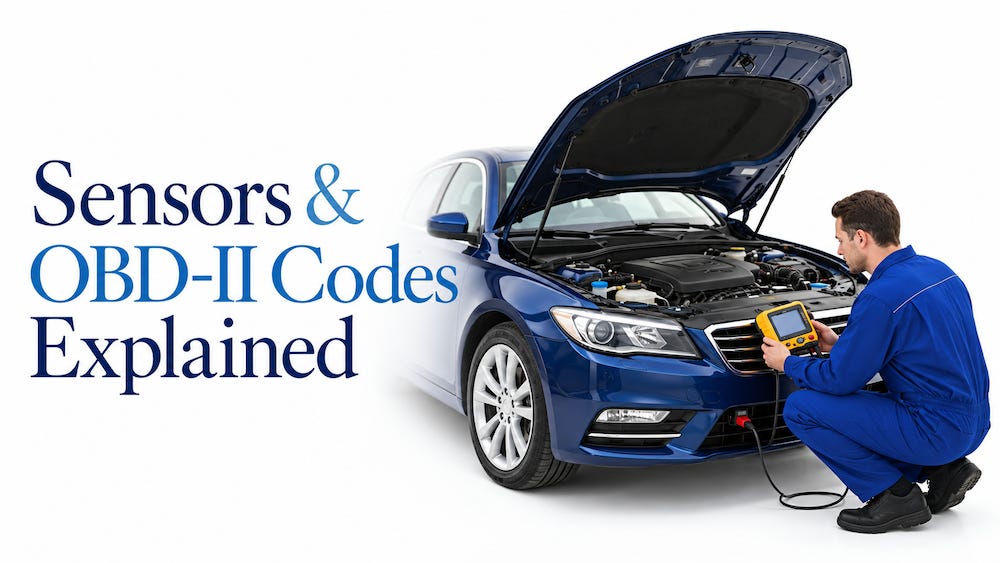
As a starting point for the OBD2 section of this blog, I will introduce and recommend literature that can help readers build a foundation before I explore individual topics in greater detail. Understanding vehicle diagnostics involves more than connecting a scan tool and looking up a trouble code. It requires some knowledge of engine operation, the purpose of individual sensors, and how the engine control unit interprets their signals.
One book worth considering is Engine Sensors & OBD-II Codes Explained by Madhurjya Dutta, founder of OBDCode.org. According to its description, the book combines explanations of common engine sensors with diagnostic trouble codes, symptoms, testing procedures, live data patterns, and troubleshooting flowcharts. Its emphasis is on identifying the cause of a problem before deciding which component, if any, needs replacement.

Moving Beyond the Trouble Code
An OBD-II trouble code provides a starting point for diagnosis. It identifies a condition detected by a vehicle’s monitoring system, but it does not necessarily identify a defective part. A code associated with an oxygen sensor, for example, may require investigation of wiring, intake or exhaust leaks, fuel delivery, or other operating conditions before replacing the sensor.
The book’s stated focus on diagnostic reasoning makes it relevant to readers who want to move beyond simply reading and clearing codes. Its description includes mass airflow (MAF), manifold absolute pressure (MAP), oxygen (O₂), throttle position (TPS), and engine coolant temperature (ECT) sensors, along with fuel, timing, and evaporative emissions topics. Understanding what these sensors measure is an essential step toward interpreting the information reported by a scan tool.
Live Data and Basic Testing
Another topic highlighted in the description is live data, including fuel trims. Trouble codes record detected faults, while live data provides a view of what the control system is reporting during operation. Observing how readings change at idle, as the engine warms up, or under load can help narrow the investigation.
The advertised coverage also includes multimeter basics, sensor testing procedures, and symptom guides for conditions such as rough idle, misfires, and vacuum leaks. These subjects connect the electronic information available through OBD-II with checks performed on the vehicle itself. However, the appropriate test method depends on the sensor and vehicle; a multimeter is useful for many basic checks, but some investigations require additional equipment and manufacturer service information.
A Starting Point for Further Learning
Based on the publisher’s description, this book appears worth considering as an introductory resource for readers interested in practical engine diagnostics. This is an introduction to its advertised scope, rather than a review based on a complete reading of the book. Claims about repair savings or professional-level results should be treated as promotional statements rather than guaranteed outcomes.
In future posts, I will examine OBD2 concepts in more detail, including the distinction between a trouble code and a diagnosis, the interpretation of live data, and the communication between a diagnostic tool and the vehicle. Introducing relevant literature first gives readers an opportunity to establish some background and follow those discussions with a clearer understanding of the terminology.