


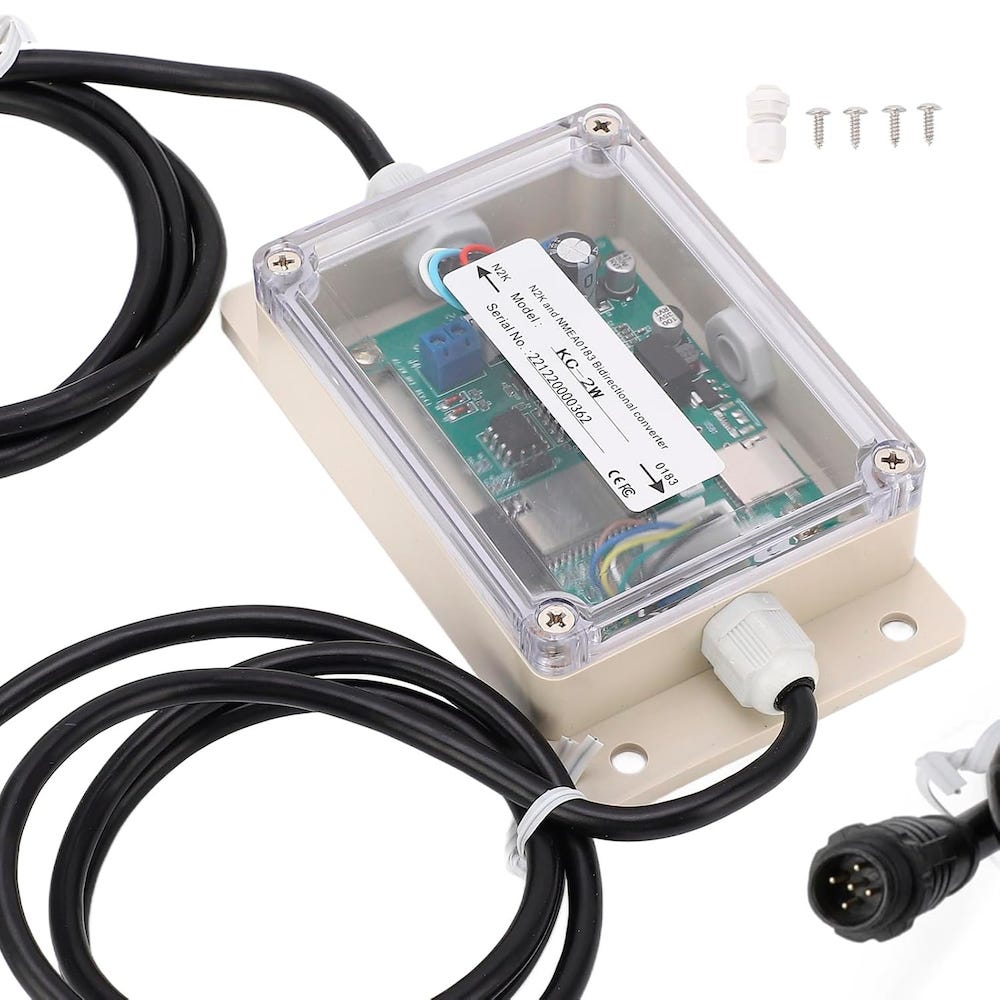
Upgrading marine electronics often creates an unexpected problem: the new equipment works, the old equipment still works, but they cannot exchange information. An older GPS receiver, depth instrument, or wind sensor may provide an NMEA 0183 interface, while a new chartplotter expects data from an NMEA 2000 network. Replacing every instrument would solve the compatibility problem, but it could also turn a modest upgrade into an expensive project.
The KC-2W bidirectional converter addresses this gap. It translates supported NMEA 0183 sentences into NMEA 2000 messages and performs the conversion in the opposite direction. This allows compatible equipment from different generations to share information, helping boat owners retain useful instruments while upgrading their onboard network.
Why a Cable Adapter Is Not Enough
NMEA 0183 and NMEA 2000 serve a similar purpose: exchanging information between marine electronic devices. However, they use different electrical interfaces, communication methods, and data formats.
NMEA 0183 transfers information as readable text messages called sentences. Each sentence carries a particular type of information, such as position, heading, or water depth. A conventional connection has one transmitting device, commonly called a talker, sending information to receiving devices known as listeners.
NMEA 2000 uses CAN Bus technology and carries information in binary messages identified by Parameter Group Numbers, or PGNs. Multiple devices communicate over a shared backbone rather than relying on individual serial connections for each data source.
Consequently, connecting the wires through a passive adapter cannot make these systems communicate. An active converter must receive a message, interpret its contents, and create the corresponding message for the other network.
What Bidirectional Conversion Makes Possible
Consider a boat with an older NMEA 0183 depth instrument and a recently installed NMEA 2000 chartplotter. If the converter supports the instrument’s depth sentences and the corresponding NMEA 2000 output, the chartplotter can receive that information through the network. The existing transducer and instrument can remain in service.
Conversion in the other direction is equally useful. Position information available on an NMEA 2000 network could be translated into an appropriate NMEA 0183 sentence for an older receiving device. A practical example is supplying position to a compatible VHF radio that requires an external GPS source.
These examples illustrate the converter’s main benefit: equipment replacement can follow the condition and usefulness of individual instruments instead of being dictated entirely by interface compatibility.
Bidirectional conversion does not mean that every possible message is translated. Compatibility depends on the converter’s supported sentences, PGNs, and conversion mappings, as well as the messages accepted by the receiving equipment.
Installation and Configuration
The KC-2W draws power through its NMEA 2000 connection, reducing the need for separate power wiring. Its NMEA 0183 input provides automatic baud-rate detection, while the output rate is configurable. Input detection does not automatically select the rate required by an older receiving instrument.
Published specifications differ between versions: the supplied listing states automatic detection up to 38,400 baud, while ONWA’s product page lists up to 115,200 baud. The documentation for the particular unit should determine installation settings.
ONWA also documents Wi-Fi for configuration and data output, with browser-based configuration and firmware-update facilities. Wireless access can make supported data available to compatible applications, but application format and connection requirements still matter.
The manufacturer lists a 9–30 VDC supply range, operation from −20°C to +55°C, and protection against overvoltage, power transients, and accidental reverse polarity. Its published waterproof designation is “IPX67,” an unusual notation that warrants clarification before choosing an exposed mounting location.
Check the Data Path Before Connecting
A successful installation starts with a simple question: which device needs which information?
Identify the source message, confirm that the KC-2W translates it, and verify that the destination accepts the resulting message. For an older instrument receiving serial data, check its required baud rate as well.
The NMEA 2000 backbone still requires correct power, termination, and connections. Automatic baud-rate detection simplifies part of the installation; it does not replace proper wiring or network planning. Where information can travel in both directions, plan the connections carefully to avoid feeding converted data back toward its original source.
For boats carrying a mixture of older and newer electronics, the KC-2W offers a practical bridge between two established marine communication standards. Its value lies in making existing information available where it is needed—and allowing useful equipment to remain useful. More information…