


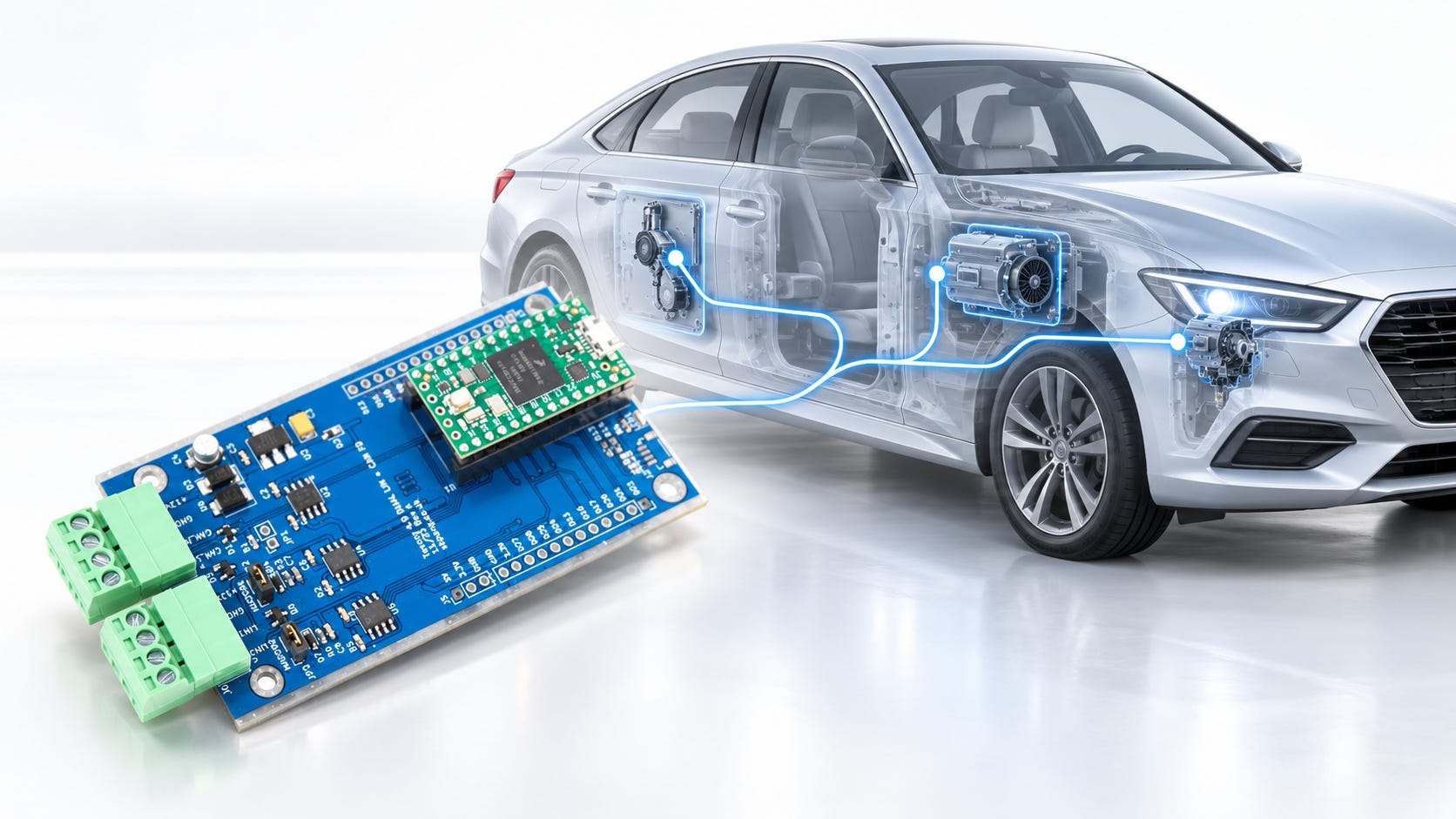
Automotive electronics often combine several communication networks, each serving a particular purpose. CAN connects electronic control units, while LIN provides an economical way to communicate with simpler devices such as sensors and actuators.
For developers working across these networks, the Teensy 4.0 Dual LIN and CAN FD Board brings two LIN channels and a CAN interface onto one compact platform. With the Teensy 4.0 included and installed, the board provides a foundation for custom firmware, bench experiments, and automotive network development.
Where LIN Fits
LIN, short for Local Interconnect Network, is a single-wire serial communication system operating at speeds up to 20 kbit/s. It is widely used for automotive functions where modest data rates and low implementation costs are appropriate. Climate-control flap motors are one example; other applications involve switches, sensors, and small actuators.
A LIN network uses a commander, traditionally called the master, to schedule communication with responder devices. This predictable communication pattern makes LIN useful for recurring control commands and status updates.
Why Two LIN Ports Matter
The board’s two LIN ports are particularly useful when a project involves two separate LIN networks. Each channel provides a connection to its own bus, allowing developers to work with both networks from one microcontroller.
Consider a bench setup with a climate-control actuator on one LIN network and a lighting module on another. With suitable firmware, the Teensy can schedule communication on each channel, issue commands, and collect responses. Both devices can participate in the same experiment while retaining separate bus wiring and communication schedules.
That arrangement offers several practical advantages:
Separate communication schedules: Each LIN network can follow the timing required by its connected devices.
More capacity across two buses: Traffic can be distributed between networks. Each bus retains LIN’s speed limit, but the devices do not all compete for one bus schedule.
Easier comparison testing: Developers can connect two devices or configurations to separate channels and compare their behavior under similar test conditions.
More flexible prototypes: One controller can coordinate two LIN subsystems, reducing the need for a second development board.
Separate LIN channels also make it possible to experiment with different bus configurations without repeatedly rewiring a single interface. The channels are separate communication interfaces; this does not imply galvanic isolation.
Applications: From Device Testing to Gateway Development
One useful application is a programmable LIN test fixture. With the appropriate message definitions and firmware, developers can send commands to a LIN device, read its responses, and repeat a test sequence. Two channels allow a fixture to exercise two separate LIN networks during the same test.
Another application is a CAN-to-LIN gateway prototype. For example, firmware could receive a command over CAN, translate it into a LIN transaction, and return the resulting status over CAN. With two LIN ports, that prototype could address devices on two different LIN branches.
This translation requires application software. CAN and LIN use different communication methods and message structures, so the board provides the hardware foundation while the firmware defines scheduling, signal mapping, and error handling.
The same platform can support educational projects that demonstrate how a central controller coordinates multiple networks. Developers can explore the relationship between CAN commands, LIN schedules, and device responses in a manageable bench setup.
Teensy 4.0 Provides the Processing Platform
Teensy is a family of compact, USB-programmable microcontroller development boards. The Teensy 4.0 uses a 600 MHz Arm Cortex-M7 processor and supports development through the Arduino IDE with Teensy software support. Its processing capability leaves room for application logic alongside network communication, such as evaluating responses, managing test sequences, or preparing data for a host computer.

The interface board adds two Microchip MCP2004A LIN transceivers and support for Classical CAN or CAN FD. It also includes a 120 Ω CAN termination resistor, an onboard 5 V regulator accepting a 7–12 V DC input, reverse supply voltage protection, and ESD protection.
For engineers, educators, and embedded developers, the main attraction is the combination: two LIN networks, a CAN interface, and one programmable controller. It creates a practical starting point for testing individual devices and exploring how multiple automotive subsystems work together.
View the Teensy 4.0 Dual LIN and CAN FD Board at Copperhill Technologies for product details.